

Does Epsom Salt Actually Work? We Read the Studies

Does Epsom salt actually work? Mostly no. Not the way the bag promises. The magnesium you paid for does not soak through your skin, and no solid evidence says it ever did. A warm soak still does a few real things. None of them are the thing printed on the front of the box, and once you can tell the difference you stop paying for the wrong reason.
You probably typed that question half-expecting the answer to be "scam." Good instinct. Hold onto it, because it is about to be useful. We sell foot soaks for a living, and we are going to spend this page telling you which parts of the pitch hold up and which parts we refuse to repeat.
Where did Epsom salt even come from?
The name is a place. In 1618, during a drought near the town of Epsom in Surrey, England, a cowherd named Henry Wicker found a pool his cattle would not drink. The water was bitter. It ran over a bed of magnesium sulfate, and that compound is what "Epsom salt" still means today. People traveled in to soak in it and drink it for the next century, and a scientist named Nehemiah Grew formally named the "bitter purging salts" in 1695. Four hundred years later the box in the pharmacy holds the same white crystal. Only the marketing changed.
Does magnesium actually absorb through your skin?
No. This is the central claim under almost every bath-salt box, and it is the weakest one on the shelf. Your skin is a barrier first. Its outer layer is fifteen to twenty stacked sheets of dead cells built to keep the outside out, and the hydrated magnesium ion is roughly four hundred times too large to cross, with no transporter to carry it through. National Geographic's science desk put it plainly: the skin mainly serves as a barrier, and it is unlikely you absorb much magnesium from a bath at all.
The study everyone points to as proof does not survive a read. It is a 2004 pilot run by Rosemary Waring at the University of Birmingham: nineteen people, no control group, never published in a peer-reviewed journal, and hosted for years on the Epsom Salt Council's own website. That is a brochure wearing a lab coat. A 2017 review in the journal Nutrients (Gröber and colleagues) weighed the whole question and landed on one sentence worth memorizing: "We cannot yet recommend the application of transdermal magnesium." When a lab does catch magnesium crossing at all, it is a trace through hair follicles, which cover somewhere between 0.1 and 1 percent of your skin (Chandrasekaran, 2016). The best human trial of a magnesium cream, published in PLOS ONE in 2017 (Kass and colleagues), did not raise blood or urine magnesium across the group. Even swallowing magnesium barely moves muscle cramps, according to a 2020 Cochrane review. A footbath is not going to beat a pill at a job the pill can barely do. If you want the mechanism pulled all the way apart, that is its own piece: does magnesium absorb through skin.
Does an Epsom salt bath "draw out toxins"?
No, and there is no mechanism for it to. "Detox" needs an organ, and you already own two good ones. Your liver and kidneys clear waste from your blood around the clock, for free, without your feet in a bucket. Salt water sitting on the outside of your skin has no route into your bloodstream to reach in and pull anything back out. No study shows it happening, because there is nothing there to show. When a label says "detoxifying," it is naming a feeling, not an event.
Does it reduce inflammation or cure sore muscles?
Also no, at least not as a soak. A 2018 meta-analysis of 99 studies (Dupuy and colleagues) ranked what actually helps soreness after training, and the support went to massage and cold-water immersion. Warm soaking was not one of the winners. This is the claim we are most careful about, because it is the one our own category loves to imply without saying. A soak can feel good on beat-up legs. Feeling and healing are different words, and only one of them is true here. It is also why what serious athletes actually soak in rarely looks like the bath-salt aisle.
So what does a warm soak actually do?
Here is the turn. Strip out the fake claims and a short list of real ones is left standing, and they are the reason a soak still earns fifteen minutes of your night.
Heat raises the blood flow to your skin. Warm your feet and the surface vessels open up. Local warming to about 42°C is the standard method labs use to push skin blood flow toward its maximum, which is why your feet flush pink in a hot basin. That is textbook cutaneous-circulation physiology, the kind of work that fills the Journal of Applied Physiology. Heat also nudges your body toward its wind-down setting. A 2025 footbath study in Cureus (Kono) measured warm water raising toe temperature and shifting heart-rate variability toward the body's rest mode, and there is more on that in the footbath-before-bed question. Warm water softens built-up skin, so calluses and rough heels give more easily afterward. And the least glamorous mechanism is the strongest one. The fifteen-minute stop is real, enforced downtime. You cannot scroll, soak, and stand at the counter at the same time. The soak makes you sit still, and sitting still is most of what recovery is.
Then why put anything in the water at all?
Fair question, and the honest answer is smaller than the marketing wants it to be. There are three real reasons, in plain view.
Scent reaches you through your nose, not your skin. That is a genuine route, and it is why a room-filling eucalyptus or lavender note changes how the ten minutes feel, without any of it crossing into your body. Menthol is the one added ingredient that earns a hard claim. It triggers the TRPM8 cold receptor, so you feel cool within a couple of minutes with no real temperature drop. That mechanism is well mapped (Peier and McKemy, both 2002), and at the dilution of a soak it is a cooling sensation, not a painkiller. The third reason is the routine itself, which does measurable perceptual work. In a 2014 experiment (Broatch), athletes who believed they were getting a real recovery treatment reported the same felt recovery as a genuine ice bath. Belief is not nothing. It is a real, earned part of why you get out feeling better.
The part a soak company is not supposed to tell you
We make recovery soaks. We could print "absorbs magnesium" on the front like everyone else in the aisle, and most buyers would never check. We are not going to. The magnesium story is thin, and repeating it would insult the exact person who reads ingredient labels for sport. Heat does the work. Menthol does the sensation. The sachet's real job is to make you actually run the soak instead of meaning to. If you want the full ledger, every claim we do make and every source under it lives on our science page, graded, with the studies linked so you can check us the same way we just checked the aisle.
The honest scorecard
| Claim on the box | Evidence | Verdict |
|---|---|---|
| Magnesium absorbs through your skin | None; skin is a barrier (Gröber, Nutrients 2017) | No |
| Draws out toxins / detoxes you | No mechanism, no study | No |
| Cures muscle soreness | The 99-study review's support went to massage and cold water, not warm soaks (Dupuy 2018) | No |
| Menthol feels cooling | Established (TRPM8; Peier, McKemy 2002) | Yes, a sensation, not pain relief |
| Warm water helps you wind down | Real and modest (Kono, Cureus 2025) | Yes |
| Softens rough, calloused skin | Real, surface level | Yes |
Is Epsom salt safe, and how should you use it?
Is Epsom salt at least harmless? For most people, yes. Skip it or ask a doctor first if you have diabetic neuropathy, because reduced sensation in the feet turns hot water into a burn you cannot feel coming. The same caution goes for broken or bleeding skin, pregnancy, or a heart condition. Do not drink it.
How hot should the water be? Around 38 to 40°C (100 to 104°F). Warm, not scalding. Hotter does not add a benefit and dries your skin faster.
How long should I soak? About fifteen minutes. Longer does not do more, and a long hot soak can leave skin drier than it started.
Does more salt make it work better? No. There is no amount of salt that switches on a benefit that was never there. Extra salt only makes the water saltier, and it stings if your skin is cracked.
If your feet are wrecked tonight anyway
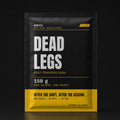
None of this changes the thing that sent you here. Your feet hurt, or you cannot switch off, and you want the ten minutes to count. A soak still helps. Not because of the magnesium, but because heat plus menthol plus fifteen forced minutes is a real recovery routine, and the sachet is what gets you to sit down and do it. Take the 60-second soak matcher and it will point you to the one built for what is actually bothering you, whether that is legs that will not settle after a shift or heels that look older than the rest of you. If you already know, Dead Legs is where most people start.