

Foot Soak for Men: Why It's Not a 'Spa' Thing

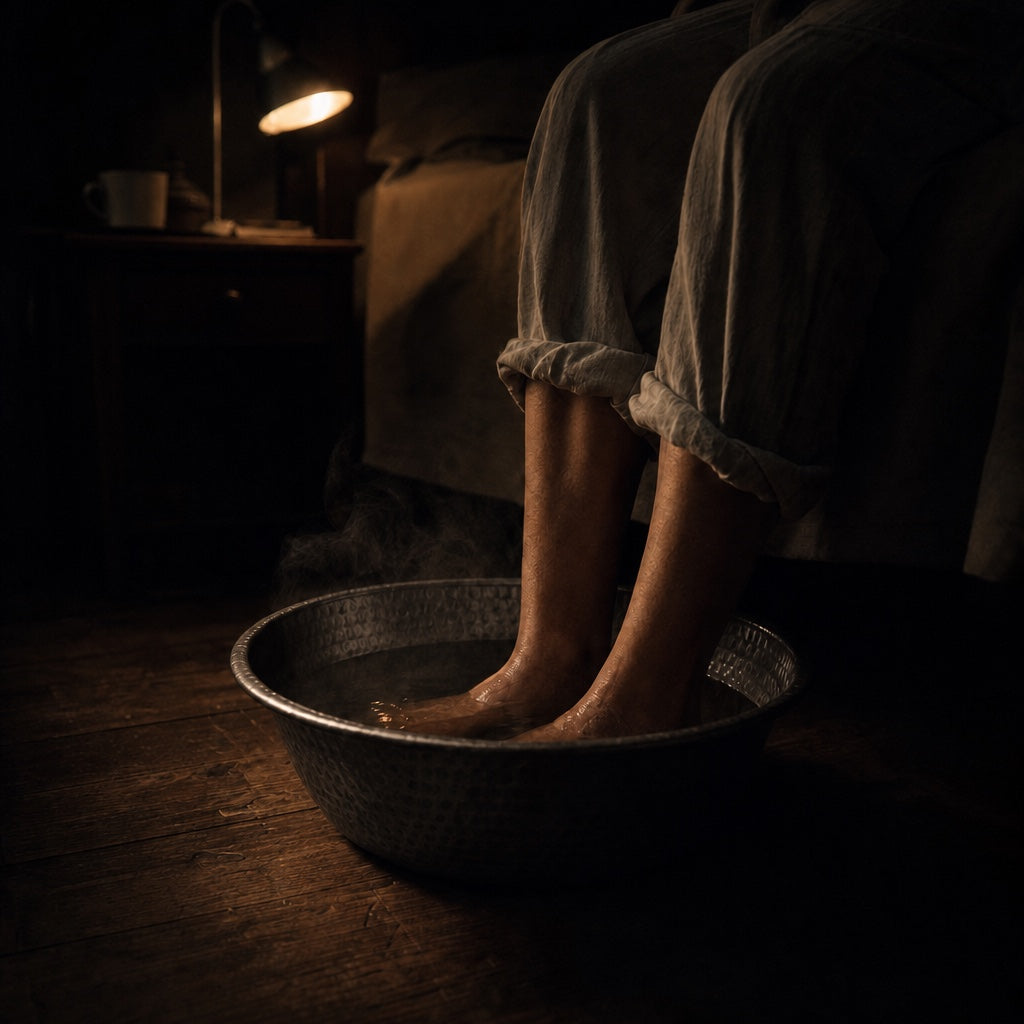
A foot soak for men is hot water, a scoop of minerals, and fifteen minutes with your feet in a basin. That is the whole thing. It is not a spa treatment, and it was never a women-only one. It is maintenance for the part of your body you stand on, train on, and ignore until it stops cooperating.
You typed "foot soak for men" and Google barely had an answer. Start typing it and autocomplete drifts toward "menopause," because almost nobody has written this for you. So here is the plain version. What a soak actually does, the three reasons men do it, and how to run one without overthinking it. Then a map to whichever question brought you here.
Is soaking your feet weird for a guy?
No. It only feels that way because the shelf is pink and the marketing is scented.
Soaking feet is one of the oldest maintenance habits there is. Roman soldiers soaked after road marches. Japanese sento and onsen culture built public bathhouses around it, and men have used them for centuries. Boxers and fighters have always soaked their hands and feet between sessions. Your grandfather probably kept a washbasin by the door for exactly this. The habit is not new or soft. The pink packaging is new. Those are two different things.
The awkwardness is real, though, and it is worth naming properly. It is not about the water. It is about being seen doing it.
Put the question on a forum where men ask each other things. How are you actually supposed to look after your feet? The thread fills up fast, which tells you how many men wanted to know. What is missing is anyone saying it first. So every guy assumes he is the only one in the house sitting in a chair with his feet in a bucket.
There is a second answer that shows up in those threads, and it is the one to watch for. Toughen up. Your feet are supposed to hurt. You will get used to it.
That is not advice. It is a way of ending the conversation, and it is why men who work on concrete go twenty years before doing anything about their feet. Getting used to something is not the same as it stopping.
Two things settle the awkwardness. First, the bar is on the floor. Dry feet and short nails already read as effort, which tells you how little anyone else is doing. Second, the men who do this are usually not the ones you would guess. Tradesmen, fighters, nurses on their sixth twelve-hour shift. People whose feet are load-bearing equipment get here first, because their feet make the argument for them.
What does soaking your feet actually do?
Three things, and none of them are magic.
First, heat moves blood. Warm-water immersion at 40°C to 42°C raises blood flow through the submerged limb to about 1.5 times its resting rate. That is the warmth you feel climb up your shins after a few minutes.
Second, water softens skin. Fifteen minutes in warm water makes built-up callus and rough heel skin easier to file down afterward. It is the same reason a barber soaks the beard before a straight-razor shave.
Third, you stop. A soak parks you for fifteen minutes where you can't walk, scroll standing up, or do one more thing. Your feet are in a bucket. That is the point.
Does more blood flow to your feet "heal" anything faster? The evidence does not go that far. Anyone telling you it does is selling you something. What you reliably get is the warmth, the softer skin, and fifteen minutes off your feet. That is already worth doing.
What are men actually soaking for?
Strip away the marketing and it comes down to one of three problems. Find yours.
Your legs are wrecked from training or work
You lifted heavy, rolled for an hour, or stood on concrete through a twelve-hour shift. Your legs are heavy and your feet are done. This is the most common reason men soak. It is the Recovery lane: warm water, a strong cooling hit of menthol, fifteen minutes while your legs cool off. The cooling shows up in about three minutes. That is the menthol, not a placebo. If you want the deeper version, here is what athletes actually soak in.
You can't switch off at night
Some men don't soak for their legs. They soak because their head won't quit at 11pm. This is the Sleep lane, and the framing matters. A warm foot soak before bed is a wind-down step, not a sleeping pill. Warm water and quiet lavender, fifteen minutes before you get in, as a way to tell your body the day is over. It will not knock you out. It gives you a routine to stop the day on. More on that here: the foot bath before bed.
Your heels are built up like armor plate
Standing, boots, and dry air turn heels into thick, cracked plate. Soaking softens that built-up skin so it files down instead of catching on your socks. This is the Skin lane: a soak that works on calluses and rough heels the boring, mechanical way. Soften, then file. No cream that promises to melt your calluses overnight. Soak, file, repeat. The full version of that job is the men's foot-care routine.
Which soak question brought you here?
Most men arrive on this page carrying one specific question. Find yours below and go straight to it. This page is the map. Those are the detail.
"My feet are done the second the boots come off." The end-of-shift soak is its own thing, with its own numbers and its own timing in the evening. That is the foot soak after work.
"I'm trying to sleep better." Warm feet before bed is a real, studied lever, and the mechanism is not what most brands claim it is. Start with the foot bath before bed.
"My feet just hurt and I don't know why." No specific job, no specific sport, they just ache. That is the general entry point, and it deserves its own page rather than a paragraph here.
"What do people who actually train use?" Fighters, runners, and lifters have their own version of this, and some of it is worth copying. What athletes soak in.
"Does the salt do anything, or is it just hot water?" Fair question, and the answer is less flattering to the category than you would expect. Does epsom salt actually work.
"What about magnesium through the skin?" It is on half the labels in the aisle. The evidence is thin, and we said so before anyone asked. Does magnesium absorb through skin.
How do you actually do a foot soak?
You don't need a ten-step routine. You need four numbers.
The protocol
- Temperature: 40°C to 42°C. Hot enough that getting in is a small commitment. Not hot enough to scald. No thermometer? Aim for hotter than a warm shower, cooler than a hot tub run high.
- Time: 15 minutes. Past 20 your skin prunes with nothing to show for it.
- Frequency: 2 to 3 times a week. Daily is fine. Match it to how hard you are using your body.
- Vessel: Any basin or bucket. A dish tub from the hardware store does the job. You do not need special gear.
That is it. The longer method is on the how it works page, but those four numbers are ninety percent of it.
Do you even need a special soak?
No. Hot water alone gets you most of the way there. The heat and the fifteen minutes do the heavy lifting, and plain tap water delivers both. That is the honest version, and most brands in this category will not say it out loud.
Here is what a made-for-it soak adds on top of the water:
- A cooling hit you can feel. Menthol brings the cold rush in about three minutes. Plain water does not.
- A scent that isn't floral. Eucalyptus and peppermint instead of spa lavender-and-vanilla, or lavender itself when you want the pre-bed version.
- Softer skin, faster. The mineral base plus a longer soak works on callus better than water on its own.
What it does not add: magnesium loading through your skin, or a cure for anything. The magnesium in Epsom salt does not absorb through your skin in any amount that matters, whatever the label says. If a product leans on that claim, read this first.
Why do most men quit after two soaks?
Because they treat it as an event. An event needs planning, and planning is what you have none of at 7pm.
Three fixes, all boring, all effective.
Leave the basin out. Under the chair you already sit in, not in a cupboard in the basement. If getting set up takes longer than two minutes, it stops happening by week three.
Attach it to something you already do. Not a time slot. A hinge point. Boots off and basin filled. Or kettle on and basin filled. The habit that survives is the one bolted to a habit that already survived.
Two or three nights a week, not seven. Daily is fine physically. It is just a bigger promise than most men keep, and a missed night feels like a failed system. Aim low enough that you clear the bar on a bad week.
The fifteen minutes is not dead time either. It is the only part of the evening where you cannot get up and do one more thing. Some men use it to eat. Most just sit.
Which soak should you actually get?
Three problems, three lanes. If you already know yours, start there. If not, the soak-matcher quiz sorts you in about a minute by asking what your body is dealing with right now.
Most men start with the legs. If that is you, Dead Legs is the recovery soak. Menthol, eucalyptus, $14 for a box. Two boxes are $26 and four are $48. Most men move up the ladder once they are soaking two or three nights a week and get tired of reordering.
Fill a bucket tonight.
Foot soak FAQ
Isn't soaking a women's thing?
No. Fighters, soldiers, and tradesmen have done it for as long as there have been fighters, soldiers, and tradesmen. The packaging turned pink somewhere along the way. The habit did not change.
How often should you soak your feet?
Two to three times a week for general upkeep. Daily is fine if you train hard or spend the day on your feet. There is no penalty for more, past the water bill.
Bucket or a real foot basin?
A bucket works. Any basin deep enough to cover your ankles works. A dedicated foot basin is more comfortable and holds heat longer, so it is a nice-to-have, not a requirement. Start with what you own.
Hot or cold water for a foot soak?
Hot, for almost everything covered here. Warm water at 40°C to 42°C is what moves blood and softens skin. Cold plunges are a different tool for a different day. For everything in this article, run it hot.
How much do you put in the water?
Follow the pack. For most foot-sized volumes that is a scoop or a sachet in a basin, not a handful in a bathtub. Under-dosing is the common mistake with plain Epsom, where men use a spoonful in ten litres and conclude nothing happened. Nothing did.
Can you soak if your heels are cracked or split?
Yes, and it is usually the right first move, because soft skin files down instead of tearing. Two rules. Keep the water warm rather than scalding, and dry between the toes properly afterward. If a split is open, bleeding, or getting worse week over week, that is a doctor conversation and not a soak.
What if you only have five minutes?
Do the five. You get the heat and some of the stop. You lose most of the skin-softening, because that is the part that needs time. Five minutes done twice a week beats fifteen minutes you keep meaning to schedule.
Why do my feet feel lighter after a soak?
Two reasons. Warm water pulls blood toward the surface, so your feet and lower legs feel warm and loose. And you just spent fifteen minutes with no weight going through your heels. That combination is the lightness you notice. It is a sensation, not a treatment.