

Heavy Legs After Running: What to Do With the Evening

Heavy legs after running is the loaded, slow feeling that shows up in the hours after a hard effort and can still be there Monday. Nothing undoes it overnight. Food, sleep and an easier next run do most of the work. What you can add tonight is fifteen minutes with your feet in hot water, sitting down.
It's Sunday evening. The long run went in this morning, you've eaten twice since, and your legs have a specific dumb weight to them. Stairs are a decision now. Runners call this dead legs, or legs like cement, and those are the words the sport came up with on its own. Tomorrow's easy four already sounds optimistic. The question nobody answers well is what you do between now and bed.
Why do your legs feel heavy after a long run?
A long run leaves the muscle tired in a way that outlasts the run. Your fuel stores are down. The fibres took thousands of small hits, most of them on the lengthening part of each stride. That's why downhill miles beat you up worse than flat ones. Your nervous system is driving those muscles at lower voltage than it was at mile two. Add general fatigue and mild dehydration, and you get legs that work but feel like they belong to someone else.
One thing it isn't: lactic acid. Lactate clears within about an hour of you stopping, so whatever is sitting in your legs on Sunday night left the building before dinner. That line gets repeated in every running thread and it's been wrong for about forty years.
Runners have a good instinct for the vocabulary, though. Fresh and dead is the axis the sport actually uses. You know what fresh legs feel like on race morning, so you already know exactly what the opposite is. That's a description of a state, not a diagnosis.
What actually helps by Monday?
There's a thread on r/Marathon_Training titled "Heavy legs after long runs: what actually helps by Monday?" Open any version of that question, on any running forum, and the answers converge fast. Eat more. Sleep more. Back off the next session. Get your iron checked.
All of that is correct. It's also the most unsatisfying advice in the sport, because none of it is a thing you do. It's a set of conditions you either meet or you don't, and by Sunday night the meeting is mostly over. You've eaten. You'll sleep when you sleep. The next run is Tuesday.
So the honest pitch here is a small one. A foot soak does not make Monday's legs fresh, and nothing in a box does. What it gives you is something to do with the fifteen minutes you'd have spent on the couch anyway. And it makes those fifteen minutes feel like the end of the day instead of the middle of it.
Why start with your feet and not your quads?
Because your quads are already getting all the attention, and your feet covered the same distance.
Running media writes the whole-body version of this article: ice bath, compression, legs up the wall, foam roller. Most of that is fine and most of it is free. But every mile landed on two feet. The arch, the small muscles under it and the ankle spent the morning absorbing that, then went into a shoe and held one shape for three hours.
There's a practical reason too. A basin of hot water is something you can do in any apartment tonight. A tub full of ice is a project, and plenty of guys don't have a bathtub at all.
How do you run the soak after a long run?
| The post-run soak | Spec |
|---|---|
| Water temperature | 40–42°C (hot-tap hot) |
| Time | 15 minutes |
| Water level | Over the ankle bone, into the calf if the basin is deep |
| When | The same evening, after you've eaten |
| Vessel | A basin, or any bucket |
| Frequency | After long runs and hard sessions, not daily |
A few notes on the numbers.
Hot-tap hot, not kettle hot. Strong going in, never scalding. If you wouldn't hold your hand under it, it's too hot.
Over the ankle. The heat only works where the water touches. Your calves ran too, so go as deep as the vessel lets you.
Not the same hour as ice. Pick one. If you were planning a cold plunge because the internet told you to, read what athletes soak in first. Cold has a real cost if you're also lifting for strength, and a thinner case than most runners assume.
Any bucket. A proper basin is coming. Until it lands, a mop bucket or a storage tub does the job, and deep beats wide. The general version of this spec is in the foot soak after work.
What is the hot water actually doing?
Two real things and one obvious one.
Heat opens the vessels near the skin. Around 42°C, local blood flow in the feet runs roughly 1.5 to 1.7 times its resting rate. Your body is pushing warm blood to the surface to shed the heat, which is why your feet go pink. Ordinary physiology, not something the soak invented.
Heat also makes tissue less stiff. Ankles that have been locked inside a shoe get to move again. If the first hundred steps after a hot shower have ever felt better than the hundred before it, that's the same effect.
Then the obvious one. You can't stand up with your feet in a bucket. Fifteen minutes of enforced sitting, no scrolling at the kitchen counter, no one-more-thing before bed. For a lot of runners that's the only genuinely still fifteen minutes of the day.
Here's what it isn't doing. A 2018 review pooled 99 studies on what reduces muscle soreness after training, and the support went to massage and cold-water immersion. Warm soaking wasn't one of the winners. We make warm soaks and we'd rather tell you that ourselves. Find it out on your own and you'd be right to stop believing the rest of this page.
What should you put in the water?
The heat is doing most of the job, so plain hot water already gets you most of the way. Everything you add is about making the fifteen minutes better, and making it likelier you do it again next Sunday. Cheapest first.
Plain hot water. Free. Works. If you take one thing from this article, run the tap and sit down for fifteen minutes.
A scoop of Epsom salt. It softens the water and gives the soak some texture, and it turns a chore into something you look forward to. Just know what it is. Magnesium doesn't meaningfully cross skin in a fifteen-minute soak, not from our salt and not from anyone's. Epsom is the base and the feel. The long version is does Epsom salt actually work.
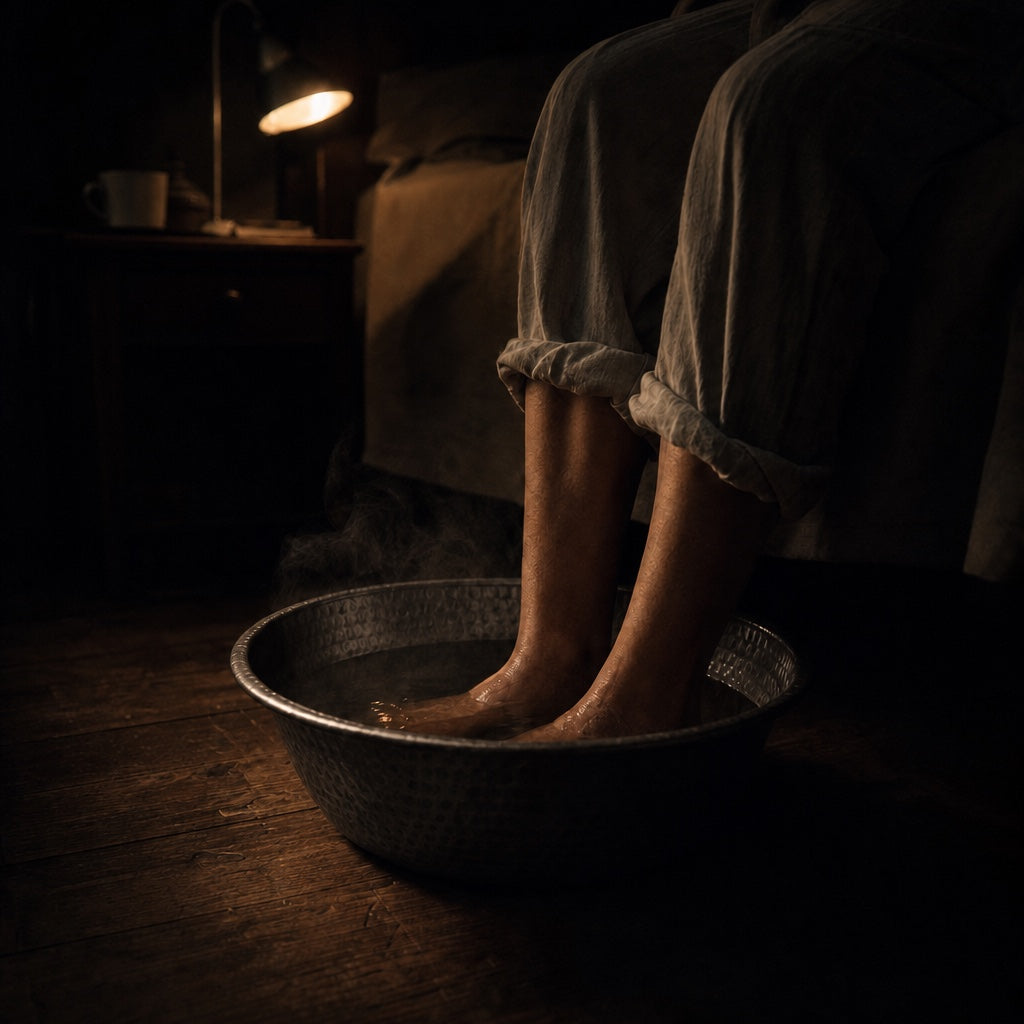
A built recovery soak. This is our lane. DEAD LEGS is dosed with real menthol. The cold comes up around three minutes in and reads clean over the heat. Menthol talks to the cold receptors in your skin. That's a sensation, and it isn't doing anything to the muscle underneath. Peppermint and eucalyptus up top, pine and vetiver underneath, so it smells like a treeline rather than a bath aisle. The sachet also does one quiet thing plain water can't. A box on the shelf is a reason to run the tap. That isn't chemistry, it's just how people work.
Start here: ANVIL DEAD LEGS, the recovery soak. One box, $14. Any bucket works. Not sure it's your soak? The 60-second soak quiz points you to the right one for how your legs actually feel.
After you step out
Pat dry, including between the toes. Don't rinse. Dry socks, not the ones from the run.
If you want a free extra, put your legs up a wall for ten minutes. Runners have been doing that forever, it costs nothing, and it's a second enforced stop. Then bed, because sleep is still the item on the list that does the most, and it's the one you control tonight.
Monday's legs will be what they'll be. The soak doesn't change the training that made them heavy and it doesn't shorten the timeline. What it changes is the shape of Sunday night. You end the day sitting down on purpose, instead of drifting to bed still wound up from the morning. Do that after every long run and it becomes the thing that closes the session out.
Questions guys actually ask
How long do dead legs last after a long run? Usually a day or two. A race or a very hard long run can leave you flat for three or four days, and the first two are the worst of it. If the heaviness is still there after a week, or it's showing up after easy runs, that's a training-load conversation rather than a soak conversation.
Should I use hot or cold after a long run? Hot, if the goal is to loosen up and switch off in the evening. Cold has a case straight after a race when you need to feel functional tomorrow, and a real cost if you're also lifting for strength. Don't stack both in the same hour. What athletes soak in lays the trade-off out properly.
Does a foot soak help next-day soreness? Not that the evidence shows. That 99-study review put massage and cold water ahead of warm soaking. What a hot soak does is feel good on beat-up legs and make you sit still for fifteen minutes. Both are real. Neither is a treatment, and we won't sell it as one.
Can I soak the night before a run? Yes. It's warm water and fifteen minutes of sitting down, and nothing about it compromises tomorrow. Plenty of guys prefer it the night before a hard session for exactly that reason.
When should heavy legs actually worry me? When they're not tied to training. Legs that feel heavy on easy weeks, or heaviness that comes with unusual breathlessness, are worth a doctor's visit rather than another article. So is one leg that's swollen, warm and sore in the calf on its own, and that one is worth going today. Persistent heaviness is also a reason to get bloodwork done. Low iron is common in this sport, and a bucket of hot water has nothing to say about it.