

Post-Marathon Foot Recovery, Day by Day

Marathon foot recovery runs in three phases: the six hours after you stop, days 1 to 3, and days 4 to 7. None of it is complicated. What matters is that you do it for your feet, and almost nobody tells you to.
You crossed the line a few hours ago. The medal is on the counter. Your quads have opinions and your calves have opinions, and every recovery article you have opened since is about quads and calves. Meanwhile the two things that actually absorbed 42.2 kilometres of ground are still inside the shoes you have not taken off.
Why does marathon recovery advice skip your feet?
Because legs are louder. The soreness that shows up on marathon night is quad-shaped, and it introduces itself on the first staircase you meet. That is the shared experience of the entire sport. There is a thread on r/running titled "Post Marathon Survival Hack: Walk down stairs backwards. That is all." There is one on r/Marathon_Training titled "Should I take PTO the day after a marathon." Go looking for the same volume of conversation about feet and it mostly is not there. The foot threads that exist tend to be one runner describing one specific pain, with nobody answering.
So the advice you get is leg advice. Protein, sleep, easy spin, foam roller. All of it fine, none of it aimed at the part of you that took every footstrike.
Your feet did a different job than your legs did. Your legs made power. Your feet took impact and held a shape while doing it, for hours, inside a shoe that got tighter as the race went on, because feet swell when you run long on them. By the last few miles your foot was working in a smaller box than it started in. The skin, the toenails and the small muscles under the arch are their own recovery problem on their own timeline, and the standard leg protocol misses them completely.
Day 0: the six hours after you stop
This is the window where everything is either easy or ignored. Here is the whole of it.
| When | What to do with your feet |
|---|---|
| First 20 minutes | Keep walking, slowly. Do not sit down at the finish and stay there. |
| Within the hour | Shoes and socks off. Look at your feet properly, in the light. |
| Hour 1 to 2 | Eat, drink, then get horizontal with your feet above your heart for 10 to 15 minutes. |
| Hour 2 to 4 | Warm shower, not scalding. Sandals or something loose after. |
| Evening | Dry socks. Feet propped on a pillow. No soak tonight. |
A few notes on that.
Keep walking first. The instinct at the finish is to sit down on the curb. Give it twenty slow minutes before you do. Running to fully stopped is the transition your body handles worst.
Take the shoes off and actually look. This is the one inspection that matters and most runners skip it. Three things: blisters, including the ones under a callus that you only find by pressing; hot spots that have not blistered yet; and toenails, especially the second and third toe. All of it is easier to deal with tonight than on Tuesday.
Feet above heart, ten to fifteen minutes. Lie on the floor, heels up on the couch. Not a technique, just gravity. Your feet have been the lowest point of your body for four or five hours.
No soak on race night. Hot water on skin that is raw or freshly opened is a bad trade. If your feet came through clean, a warm soak is fine. If they did not, wait a day. Nothing gets worse for waiting. Keep them in something loose for the rest of the day either way, because your feet are still swollen and anything structured undoes the point.
Day 1 to 3: the stairs days
Day 1 is the famous one. This is when going down a flight of stairs becomes a comedy routine and the sideways shuffle enters your life. Down is worse than up, and that is normal.
Your job on these three days is small and boring.
Walk, on purpose, several times a day. Ten or fifteen minutes each, flat ground, easy shoes. Walking is what makes the next morning better, and it is what everybody skips in favour of lying still.
Stay off stairs where you can, and go down backwards where you can't. The running forums arrived at that one on their own, and it works because it changes which muscles control the descent.
Wear the softest shoes you own. Not your race shoes, not work boots. Your feet are still a size bigger than they think they are.
Check the toenails once a day. A dark toenail after a marathon is common and usually just pressure. If pressure is building under the nail rather than settling, that is a doctor question, not a home one.
Do not test anything. No "just a short run to see." Day 3 is not a fitness test.
What should go in the water from day 1 on?
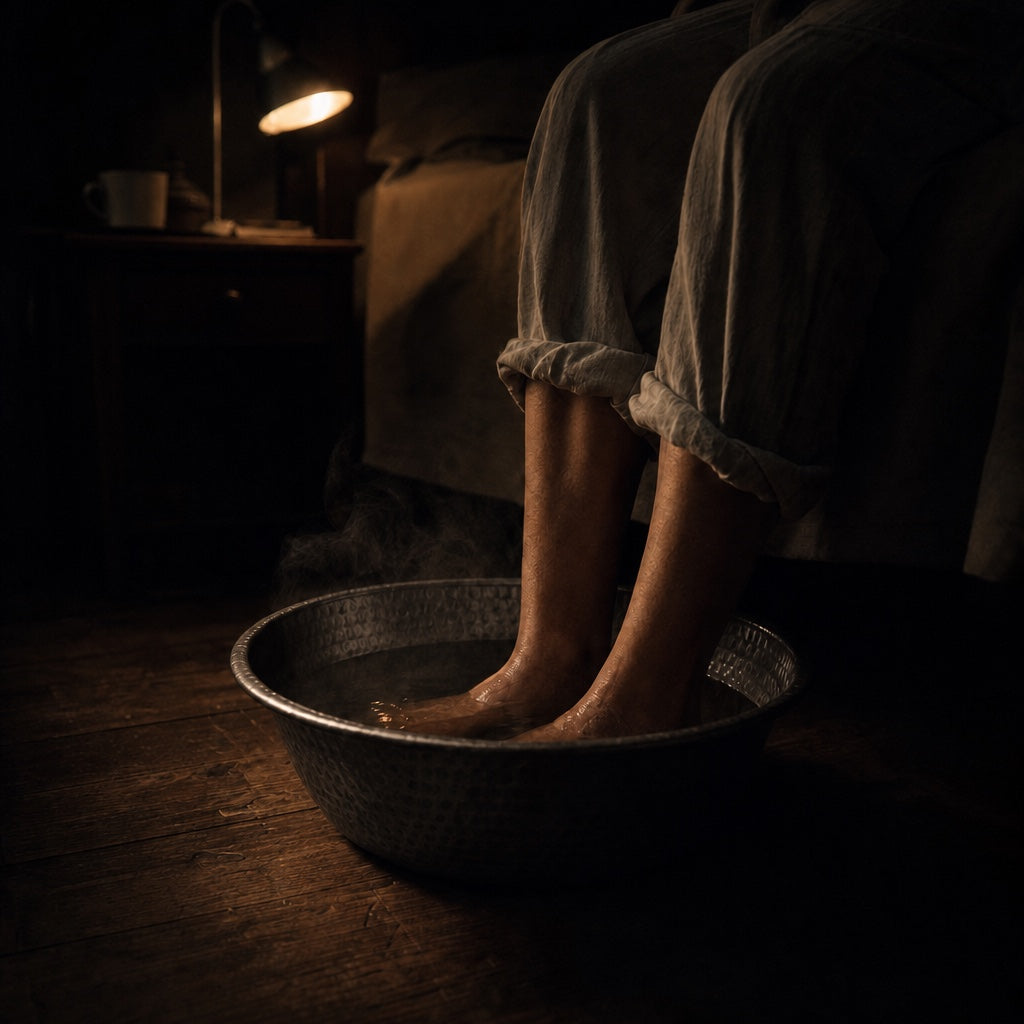
Once the skin is intact, the evening foot soak is the single most useful thing you can do for your feet in this week, for a reason that has nothing to do with magic.
Hot water at 40 to 42°C, fifteen minutes, filled up over the ankle bone. Around 42°C, local blood flow in the feet climbs to roughly 1.5 to 1.7 times its resting rate. Warmth on the skin widens the vessels underneath it, and a foot that has been carrying your whole body all morning gets moved through instead of sat in. Heat also makes tissue looser and less stiff, which is the opposite of what your feet have been all day.
Then there is the part nobody sells you, which is the fifteen minutes itself. You cannot walk around with your feet in a basin. In a week where the correct plan is "do less," a soak is a forced stop with a timer on it. That is most of the value, and it is free.
What you put in it, honestly ranked:
Plain hot water. Works. If you do one thing from this article, this is the one.
A scoop of Epsom salt. It changes how the water feels and makes you more likely to come back tomorrow night. Be clear on what it is not. Magnesium does not meaningfully absorb through skin in a fifteen-minute soak, from any brand (we took that claim apart here). The heat does the work. The salt is the texture.
A built recovery soak. ANVIL DEAD LEGS is the recovery soak in the line, dosed with real menthol. The cooling comes up a few minutes in and reads clean over the heat, ankle to calf. Understand what that cold is: something your nerves report, not something that switches off what your feet are telling you. Peppermint and eucalyptus over pine and vetiver, closer to a treeline than a bath aisle. The sachet also settles the argument you have with yourself on the fifth night, when the basin feels like effort and the box on the shelf is already paid for.
Start here: ANVIL DEAD LEGS, the recovery soak. One box, $14. Vessel is whatever holds water and both feet: a mop bucket, a storage tub, the thing you wash the car with. Our own basin is still in development. Not sure DEAD LEGS is the right one for you? The 60-second soak quiz sorts it out.
Runners are not a special case here. It is the same occasion a guy on a concrete floor has at 6pm, pointed at a different day. The general version is the foot soak after work, and what athletes soak in covers the rest of the category.
Day 4 to 7: the part with the decision in it
Around day 4 the legs start negotiating for a run. Your feet are usually the ones still saying no, and they are the ones worth listening to.
Skin catches up on its own schedule. Blisters that were tight on day 1 are usually flat by now. Rough heels get worse this week rather than better, because miles and hot showers and sweat all pull moisture out of skin that was already dry. If yours have gone hard at the back, work a thick cream in at night after the soak, while the skin is still soft. A proper foot cream is coming; any thick one does for now.
The gate for your first easy run is not the calendar and it is not your quads. It is this: you can walk downstairs normally, and no single spot on either foot hurts more than the rest. If both are true, go run short and easy. If either is not, take another few days. Nothing in a marathon block is won in the week after the marathon.
When it is not recovery
Everything above assumes ordinary post-race wreckage. Some things are not that, and this is where the internet is the wrong tool. Go see a doctor or a physio if:
- One specific point on the top or outside of your foot hurts sharply when you put weight on it, especially if it is worse on day 4 than it was on day 1.
- Pain is on one foot only and clearly localised rather than general and everywhere.
- Numbness or pins and needles in the foot or toes has not gone by day 2 or 3.
- Swelling stays put after a couple of days, or one foot is visibly bigger than the other.
- A toenail is throbbing with pressure building under it rather than easing off.
None of that is a soak problem and nothing on this page is aimed at it. Post-marathon feet that are generally trashed get better with time and walking. A single angry spot that gets worse instead of better is a different thing, and it deserves professional eyes early, while it is still small.
Questions runners actually ask
Should I soak my feet after a marathon? Yes, from day 1 onward, once you have checked that the skin is intact. Skip it on race night if you have open blisters or raw patches. Hot water at 40 to 42°C, fifteen minutes, up over the ankle bone.
Ice bath or hot water for my feet? For the feet specifically, heat, starting the day after. Cold has a case in the first hours if you are chasing swelling down, but what your feet want across the whole week is heat and time off them. Cold water on wrecked skin is unpleasant enough that you will not repeat it, and repeating it is what matters.
Why do stairs hurt so much more going down? Because going down asks the muscle to lengthen under load rather than shorten, and that is the loading pattern that leaves you sore. It is mostly a quad story rather than a foot story. Feet just get the blame because they are what hits the step.
How long until my feet feel normal? Most of the day-to-day awfulness is gone by day 4 or 5. Toenails and skin run on a longer clock, sometimes weeks for a nail that took a beating. That is normal and not a reason to stop running.
Should I take the day after off work? If you can, take it. Runners ask this every autumn and the answer from anyone who has done it is the same. A day of standing on a hard floor is the worst thing you can hand your feet 18 hours after a marathon. And yes, you can soak every night that week. Fifteen minutes of hot water is gentle, and this is the week where the forced sitting is worth the most.