

Why Your Feet Are Wrecked After a Day on Them

Your feet hurt after work because standing still is a harder job than walking, your boots hold the foot in one shape for ten hours, and everything in your body has spent the day being pulled downward. All three are ordinary. None of them mean something is wrong with you.
In 2012 somebody posted this to r/AskReddit: "I started a new factory job last Thursday. I stand on concrete for 8 hours a day. Today my feet hurt so bad I had to run to the bathroom, cry, and rub my feet while sitting on the toilet. Help?" That title is more than a decade old and still describes a Tuesday for a few million people. It also names the two strange things about this problem. It is completely universal, and almost nobody says it out loud.
This page is the long answer: what is happening in your feet, what the standard advice is worth, how it plays out in your job, and what to do in the hour after you get home.
Why do your feet hurt after standing all day?
Three things are going on, and none of them are injuries.
Standing is not resting. Walking loads and unloads your foot with every step, which is a rhythm your body is built for. Standing in one place holds the load on. The arch stays loaded, the small muscles under the foot never switch off, and there is no unloaded half-second to recover in. That is why six hours behind a counter can beat eight hours walking a job site.
Your boots hold the foot in one shape. A steel toe and a stiff sole are doing a real safety job, and the price is that your foot cannot splay or flex for the length of your shift. Feet swell over a day. A foot that swells inside a box that does not is a foot spending the afternoon in a smaller space than it needs, and heat and sweat make the boot less forgiving as the day goes on, not more. There is a thread on r/Construction titled "Work boots have cooked my feet," which is a better description than anything a footwear brand has published.
Gravity gets the last word. Your feet were the lowest point of your body for the whole shift, and blood has to climb back up out of them. Over ten hours a little fluid settles down low. That is the heavy, full feeling that arrives the moment you pull the boots off, and it is why putting your feet up on a wall feels so disproportionately good. You spent the day sending everything downward.
Put together: a foot loaded without moving, held in one shape, and slowly filling up, for as long as you were on shift. Not damage. A predictable result, and most of it undoes overnight if you give it anything at all.
The advice everyone gives you, ranked honestly
Ask this question anywhere online and you get the same list every time. Shoes, insoles, two pairs rotated, compression socks, an anti-fatigue mat, stretch, roll a ball under your arch, put your feet up, Epsom soak, "you'll get used to it," see a podiatrist, quit.
That list is not wrong. It is just presented flat, as though every item were equally proven, and they are nowhere close. Here is the same list sorted by how much it holds up. We sell a foot soak, so read the soak entry with that in mind, and note that our own upcoming compression sock lands in the middle tier, not the top one.
What genuinely works
Sitting down. The most effective intervention for load is removing load. Free, unglamorous, and plenty of guys go clock-in to clock-out without doing it once. Any break with your weight off your feet beats most of what follows.
Shoes that fit, and two pairs rotated. Boring and correct. Different shoes shift pressure to slightly different places, and each pair gets a day to dry out. A wet boot is a softer, worse-supporting boot. If you change one thing, change this.
Anti-fatigue mats, if you have a fixed station. They only help if you stand in roughly one place, which rules out most trades and covers a lot of retail, kitchen and machining work. Where they apply the effect is real and mechanical, and it is a cheap ask that often gets a yes.
Elevation. Feet above heart, ten to fifteen minutes. Straight physics against the gravity problem above, and the cheapest thing here.
Heat. Around 42°C, local blood flow in the feet climbs to roughly 1.5 to 1.7 times its resting rate. Vessels near the surface widen when warmth sits on them, so a foot that spent the day as a dead end gets more traffic through it. Heat also makes stiff tissue looser. Small, measurable, well understood, and the entire real case for a hot soak.
Oversold, but not useless
Insoles. Sold as a solution, actually a fit adjustment. A good one can change how load lands in a boot that was close to right already. It will not rescue a boot that is the wrong size or shape, which is what most people are asking it to do. Custom orthotics are a different thing again, they run into real money, and they belong to a medical conversation rather than a shopping one.
Compression socks. Middle tier, and ours is coming, so read this knowing we will be selling one. The evidence for compression during and after exercise is mixed and mostly modest, and the evidence for a standing shift is thinner than the marketing implies. Plenty of people on their feet all day do report their legs feel less heavy in them, which is worth something. Buy them knowing the felt effect is the main claim anyone can truthfully make.
Rolling a ball under your arch. Feels excellent, costs nothing, do it if you like it. Whether it changes how your feet feel tomorrow is much less clear. A pleasant five minutes, not a recovery plan.
Mostly folklore
Epsom salt as a mineral delivery system. Magnesium does not meaningfully absorb through your skin during a foot soak. Not ours, not anyone's. What the salt does is change how the water feels and give the soak some ceremony, which makes you more likely to do it again tomorrow. That is a real benefit and worth the four dollars. It is just not the benefit on the box. The heat is the active part, and the water was already hot.
"You'll get used to it." Half true and useless as a plan. Feet do adapt somewhat over the first few weeks of a standing job, which is why new starters have it worst. But "wait it out" is what gets handed to a nineteen-year-old on day three, and it is what a guy on r/skilledtrades was describing when he titled a post "30 years in the trade and i only sorted my feet two years ago." Twenty-eight years of getting used to it.
Quitting. Sometimes the right answer. Almost never an available one. Suggested constantly by people who are not standing on that floor tomorrow.
Diagnosing yourself. Not on this list at all. Something specific and persistent gets a section further down, and it is not a shopping problem.
What does it look like in your job?
The mechanism is the same everywhere. What differs is which part of it gets you.
Trades and concrete floors. Concrete gives back nothing. Every step returns the full force to your foot, and a steel-toe boot adds weight and takes away flex. r/Construction runs the same thread on repeat: "Sore feet after work, any remedies?", "What actually helps with foot pain after standing on concrete all day?", "how can i make my feet hurt less from safety boots." The awkward part on a site is that the obstacle is not knowledge, it is visibility. Nobody wants to be the guy visibly looking after his feet in front of the crew. The answer to that is not persuasion, it is doing it at home where nobody is watching. Boots and socks first, evening routine second. Boots also do a number on the skin at the back of the heel, which is its own problem: cracked heels in men.
Hospital and 12-hour shifts. The nursing subs run this constantly, from "aching feet after a long shift" to the one that names the real problem: "What is the first thing you do when you get home from a 12 hour night shift?" A 12 is not just a long 8. It is a shift structured around never sitting, on hard flooring, in shoes chosen for wipe-clean rather than comfort, often overnight when everything already feels worse. The trap is that you get home with barely enough time to sleep, so fifteen minutes feels impossible. It is worth fifteen minutes anyway, and it is worth more before bed than at any other time of day.
Warehouse and retail floors. r/AmazonFC has "My feet are KILLING ME." r/AskRetail has "Sore feet from standing all day." r/walmart asks "Is anyone else in a lot of pain after standing all day during their shift?" The pattern is high step counts with no control over pace and no permission to stop, which is the worst version of the load problem: constant, and dictated by someone else's clock. If your job has any flex in it, moving beats standing still, and micro-breaks off your feet are worth more than they look.
Kitchens. One square metre for a whole service, on tile, in the heat, with grease making every shoe choice a compromise. r/Serverlife runs "Feet feeling achey after 16 hr shifts" and "Recovery After a Shift" on rotation. The heat is the underrated part: it swells feet faster and dries the skin out over months. Kitchens are also where the anti-fatigue mat argument is most winnable, because most stations really are fixed.
Driving. Different enough to say so plainly. If you drive for a living your problem usually is not load, it is the opposite: hours seated, one foot in one position, nothing moving. The complaint that comes up is swelling rather than soreness. We are not going to build a soak routine around swelling, because persistent swelling is a medical question. Get out and walk when you stop, and take swelling that stays put to a doctor rather than to the internet.
The hour after is the thing you actually lost
Here is the part the whole category gets wrong. It writes about the shift. The shift is not what you lose.
Somebody on r/PlantarFasciitis put it exactly right in a thread title, asking what people do to stay productive at home once work is over and their feet are killing them. That is the real question. You got through the day. You always get through the day. What you did not get was the evening. The first hour went to sitting very still, and by the time your feet stopped shouting it was time for bed.
Nobody is offering you a body that does not get tired. What is available is that hour. Fifteen minutes of the right small thing on arrival buys back the rest of the night, and that is the whole trade.
Here is the order that works.
- Boots and socks off at the door. Not in an hour, now. The sweated-through sock is doing you no favours.
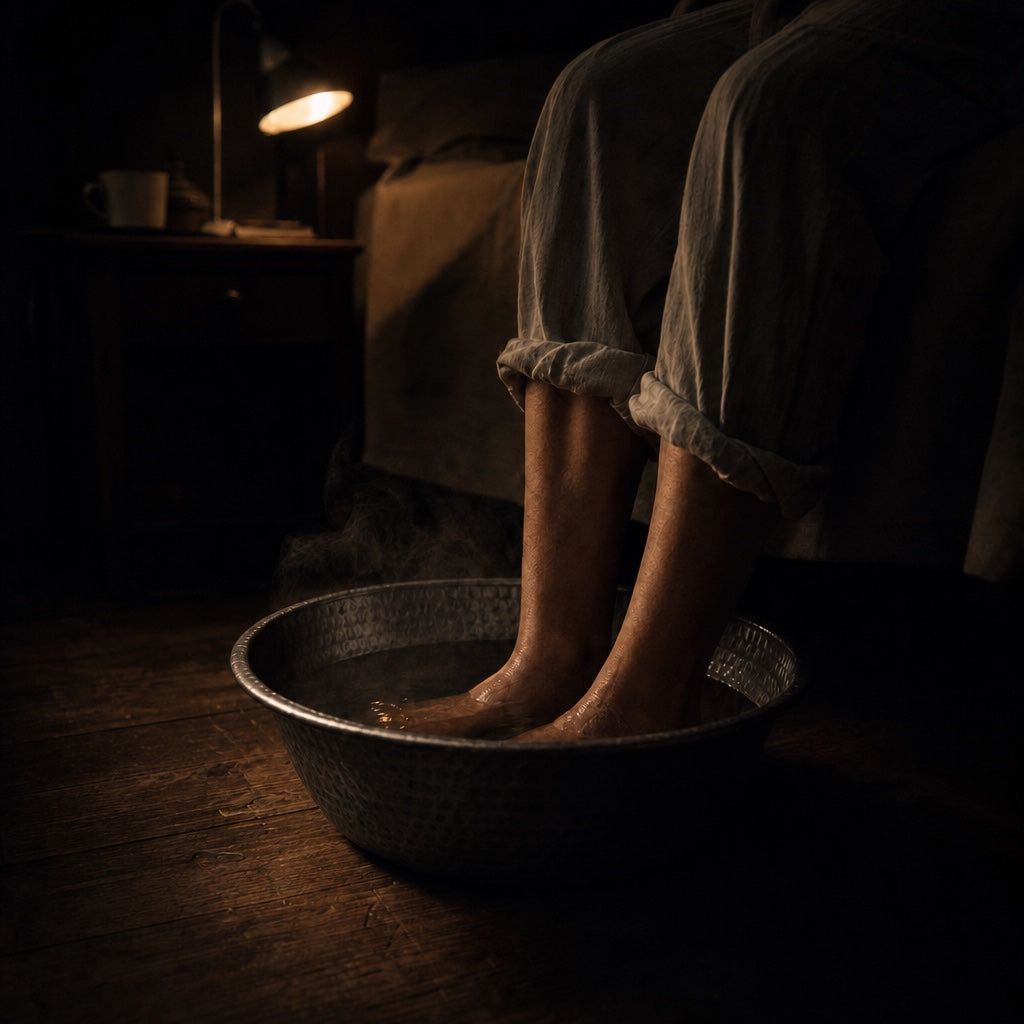
- Fifteen minutes in hot water. 40 to 42°C, up over the ankle bone, in a basin or any bucket that fits both feet. Set a timer, leave your phone in the other room. The forced stop is half of what you are buying. Full protocol: the foot soak after work, done right.
- Dry properly, between the toes included. Then cream, if your heels have gone rough, while the skin is still soft.
- Clean dry socks. Then get on with your evening. That is the point of all of it.
Two or three nights a week, on the days that earned it, is enough to stop each shift starting where the last one left off.
Where to start: the 60-second soak quiz asks how your feet actually feel at the end of the day and points you at the right soak instead of making you guess from a shelf. If you would rather read first, foot soaks for men is the plain guide, and it deals with the part most guys are actually stuck on, which is not the how.
When to stop reading this and get it looked at
Everything above is about ordinary end-of-day feet: tired, heavy, sore, better in the morning. Some things are not that, and no soak, sock or insole is the right answer to them. Go see a doctor or a physio if:
- Swelling stays put after a night off your feet, or one foot or ankle is clearly bigger than the other. One-sided swelling is worth getting checked promptly rather than waiting.
- The pain is sharp and lives in one specific spot rather than being general, especially if it is worse week over week.
- The first few steps out of bed are the worst of your entire day. That is a specific pattern with a specific name and a real treatment path, and self-diagnosing it from a search result is how people waste six months.
- Numbness, burning or pins and needles show up and stay.
- You have diabetes or any circulation condition. Hot water, temperature and foot checks should all go through your own clinician first, not through an article.
None of that is a failure of toughness. Feet that hurt every day and never get better are worth twenty minutes of a professional's time, and the people who go early are consistently glad they did.
Questions guys actually ask
Why do my feet hurt more standing still than walking? Because walking loads and unloads the foot with every step, and standing keeps the load on continuously. Your arch never gets the unloaded half-second it uses to recover. A shift in one spot is genuinely harder on your feet than a shift spent moving, which is why people notice it most when they switch from a moving job to a static one.
Is it normal for my feet to hurt after a 12-hour shift? Yes, and it gets asked in almost exactly those words on half a dozen subreddits every week. Tired, heavy, sore feet that recover overnight are the expected result. Feet still bad in the morning, swollen on one side, or hurting in one sharp spot are a different conversation and belong with a doctor.
How long until my feet get used to a standing job? Most people report the worst of it easing over the first two to four weeks. That adaptation is real but partial, and it is a reason to expect improvement rather than a reason to skip good boots, rotated shoes and an evening routine.
Does a foot soak actually do anything, or is it just nice? Both, and it is worth being precise. The heat opens blood flow near the skin and loosens stiff tissue, which is small and real. The fifteen minutes sitting with your feet off the floor is bigger than people credit. What is not real is minerals soaking into you through your skin. If a product tells you that, it is selling you the water.
Hot or cold water for sore feet? Hot for the everyday kind, tired and stiff after a long shift. Cold makes more sense for a fresh, angry flare-up like a rolled ankle in the first day or two. If your feet swell and stay swollen, skip both and see a doctor.
What if I cannot afford new boots right now? Start with socks, the cheapest real upgrade available, and with the fifteen minutes at the end of the day, which costs nothing but hot water. Both are worth doing on their own, and neither is a consolation prize.