

The Foot Soak for Sore Feet, Ranked

A foot soak for sore feet means water at 40 to 42°C, fifteen minutes, deep enough to cover the ankle bone. The heat does most of the work. Everything you put in the water changes how the fifteen minutes feel, not how well they work.
That last sentence is the whole article, so it goes first. If you came here to find out which salt does the job, the answer is that the hot water is doing most of it. The rest is still worth doing. Just not for the reason most of the internet gives you.
Why are your feet sore?
It doesn't take a job to wreck your feet. Sore feet come from a long day, and long days come in a lot of shapes.
Maybe you started a new job and you're on your feet eight hours after years at a desk. Maybe it was one bad pair of shoes. A weekend of moving furniture. Four flights of stairs, twenty times. A concert, an airport, a trade show on carpet laid over concrete. Some guys get this every shift for thirty years. Some get it twice a year and can't work out why they're walking sideways to the kitchen.
The mechanism underneath is the same one every time. Standing is not resting. The arch carries load the entire time, and the small stabilising muscles never get to switch off. Moving blood back up out of your feet is uphill work, all day long. By evening a little fluid has pooled at the bottom. That's the heavy, tight, hot feeling that arrives the second you finally sit down.
None of that is an injury. It's a foot that held one shape under load for too long. It comes undone faster than you'd expect.
If this is an every-shift thing for you, the version built around clocking out is here: foot soak after work. That one has the timing, the routine, and what to do with the rest of your evening. This article is the general one. Any sore feet, any cause.
The soak, in numbers
Here's the whole thing. No equipment you don't own.
| The soak | Spec |
|---|---|
| Temperature | 40–42°C (hot tap, not kettle) |
| Duration | 15 minutes |
| Depth | Over the ankle bone |
| Container | Any bucket or tub that fits both feet |
| How often | Whenever they've earned it |
| Phone | In the other room |
40 to 42°C. Think hot tap, not boiled kettle. It should read as strong the moment you go in, and never as scalding. Your own hand is the gauge. If you can't leave it under the running water, don't put your feet in. No thermometer required.
Over the ankle bone. Whatever the water reaches is what gets treated, and your ankles put in the same day your feet did. Fill it higher than looks necessary. This is the spec people most often get wrong, because a shallow tray is easier to carry.
Fifteen minutes. Far enough in for the heat to reach everything, close enough that you'll bother doing it again on Thursday. Set a timer so you stop checking the clock.
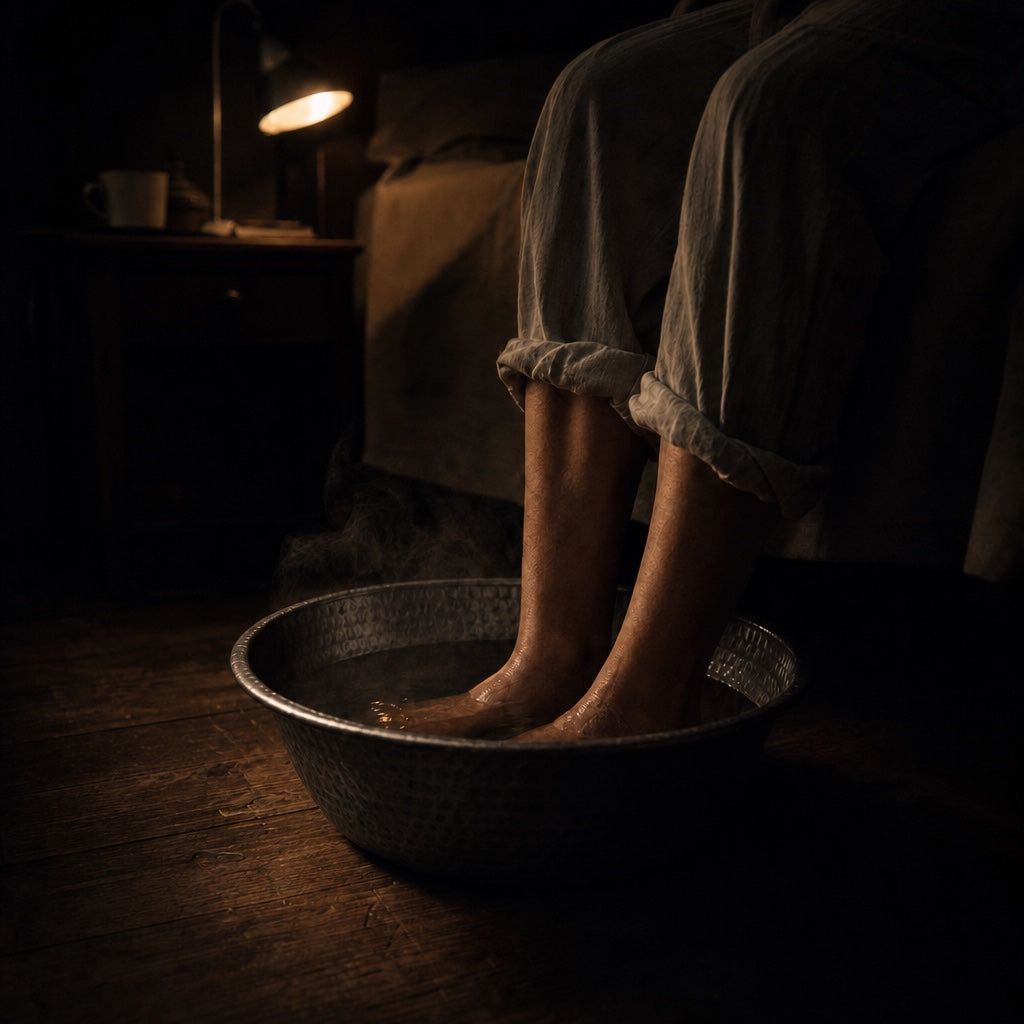
Any bucket. Whatever holds water and takes two feet. People use mop buckets, storage totes, camping tubs, the thing the car sponge lives in. Height matters more than width, since tall sides put more of the foot under. We have a purpose-built basin on the way. It is not a prerequisite.
Phone in the other room. The step everyone drops, and it carries more than it looks like. Fifteen minutes pinned to a chair is an enforced break, and the break is doing real work here.
What is the hot water actually doing?
There are three, and none of them are complicated.
Warm water opens the blood vessels sitting near the skin. Your body dumps heat at the surface, and your feet get run through with warm blood on the way. Heat also loosens muscle and connective tissue. A foot held in one position since morning is finally allowed to move differently.
Then the third one, the least impressive and the most important. A bucket pins you to a chair. That's fifteen minutes with nothing at all on your feet, which is the one thing they haven't had since morning. Load is the problem. Taking the load off is the answer. Most guys will not sit down on their own. This is what gets them to.
That's it. That's the mechanism. Heat, and stopping.
What should you put in the water?
Now the ranking, cheapest first. Read this as a ladder, not a scoreboard. Every rung works.
Plain hot water. Free, and it already does the job. If you read nothing else here, run the tap hot, fill something, sit down for fifteen minutes. There is no shame in stopping at this rung, and a lot of people should.
A scoop of Epsom salt. Cheap. It softens the water and turns the soak into something rather than a chore. Just know what you're buying. Magnesium does not meaningfully cross your skin in a fifteen-minute soak, so the salt is not feeding your muscles anything. Ask around and you'll find that's already the consensus among the people who soak most. The benefit is the heat. The salt came along for the ride. We wrote the long version, with the evidence, at does Epsom salt actually work. Short version: use it because you like it, not because it's medicine.
A built soak. This is our lane, so read the next paragraph with that in mind.
A soak built for a specific problem does two things plain water can't. First, it puts a sensation in the water that you can feel and time. Menthol comes up cool around minute three and reads clean over the heat. That is a sensation, not a painkiller. The difference between those two words is why we're careful about it. Second, and less romantically: it takes up space. A box on the shelf is a standing reminder that you already paid for this. It also runs down as you use it. Free hot water never runs low and never sits in your eyeline. That's most of why people mean to soak and don't.
Six soaks, $14 each, and they're built for different nights. Sore and heavy after a long day is one problem. Feet that run hot when you're trying to sleep is another. Heels that have been through winters and boots is a third.
Start here: the 60-second soak quiz asks how your feet actually feel and points you at the one that matches. It's the fastest way to not buy the wrong thing.
For the wider guide to soaking as a guy, including the part about feeling stupid doing it, read foot soak for men.
When should you skip the soak?
A hot soak is a mild thing to do to yourself. It is not the answer to everything. A few times, skip it and see a doctor instead.
Swelling that stays, or swelling on one side only. If a foot is still visibly bigger the next morning, that's worth a real opinion. Same if one is bigger than the other. Hot water will not sort it and can make it feel worse.
Open or bleeding cracks. If your heels have split deep enough to bleed, skip the soak. Softening the skin around an open split works against something that needs to close. Get it looked at.
Numbness, tingling, or feet that don't register temperature properly. This is the important one. The 40 to 42°C rule assumes you can feel the water. If your feet don't reliably report back, you can burn yourself without noticing. Don't guess at the temperature, and check with your doctor before making hot soaks a habit.
Fresh, angry, swollen injury. A rolled ankle in its first day or two wants cold, not heat.
None of that describes most sore feet at the end of most long days. But it's a short list and it's worth reading once.
Questions guys actually ask
What should I soak sore feet in? Hot water. That's not a dodge, it's the finding. Run it to 40 to 42°C, fill past the ankle bone, sit for fifteen minutes. Epsom salt makes it feel better and costs almost nothing. A built soak adds a sensation you can feel and makes you more likely to keep doing it. In that order.
How hot should the water be for sore feet? 40 to 42°C, which is roughly what a hot tap gives you. Strong going in, never scalding. Use your hand as the gauge. If you can't leave it under the running tap, your feet shouldn't go in either.
How long should you soak sore feet? Fifteen minutes. Ten still works. Twenty is fine. Past that you're just sitting in cooling water, and the returns flatten out well before your skin goes pruney.
Does Epsom salt actually help sore feet? It helps the soak feel better. It does not do anything to your muscles that the hot water wasn't already doing. That's also the consensus among people who've soaked for years. Use it because you enjoy it.
Hot or cold water for sore feet? Hot, almost always. The everyday version is tired, stiff and heavy, and that responds to heat. Save cold for a fresh injury in its first day or two, while you're still settling it down. Most sore feet are not that.
Can I soak every day? Yes. A fifteen-minute soak is mild enough to repeat. If nightly is what gets you off your feet, go nightly. For most people two or three times a week is enough, kept for the days that earned it.
Do I need a proper foot basin? No. Anything that takes two feet and enough water to clear the ankle bone will do. Tall and narrow beats short and wide, for the same reason: more foot under water. Ours is on the way. Not owning one is not a reason to skip this.